Democratic Center for Middle East Studies North Carolina — United States of America
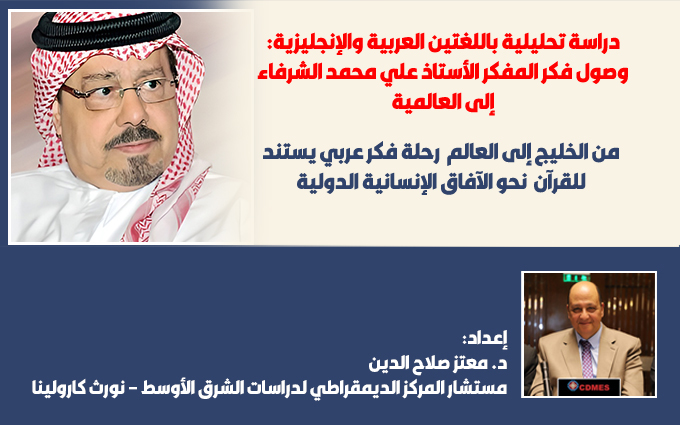
ANALYTICAL STUDY The Global Reach of the Thought of Thinker Ali Mohammed Al-Sharafa Al-Hammadi From the Gulf to the World — An Arab Intellectual Journey Rooted in the Qur'an, Reaching Toward Universal Human Horizons
Prepared by: Dr. Moataz Salah El-Din Advisor, Democratic Center for Middle East Studies — North Carolina, United States of America I. Introduction — The Thinker and the Universal Question Ali Mohammed Al-Sharafa Al-Hammadi represents a singular model of the Arab intellectual who refused to confine his vision within geographical borders or local ideological frameworks. Drawing from the very core of the Islamic and humanistic heritage, he raised fundamental questions that touch the human mind in every corner of the world. His intellectual output is organized around three major axes: the re-reading of the Qur'anic text in the light of reason and dialogue; the critique of closed ideological thinking; and the advocacy of a shared human framework that transcends religious and cultural boundaries. Taken together, these axes are precisely what have opened the gates of universality to his thought. II. Factors Contributing to the Universality of His Thought Several converging factors explain the wide dissemination that Al-Sharafa Al-Hammadi's thought has achieved beyond the Arab world. They may be summarised as follows: 1. An Inclusive Humanistic Approach: Al-Sharafa Al-Hammadi did not treat questions of religion and identity from a narrow defensive perspective. He presented them as shared human concerns relevant to every seeker of truth — a framing that rendered his ideas receptive across a wide range of cultures. 2. Intellectual Courage and Textual Integrity: His arguments are grounded in the Qur'anic text itself, free from ideological guardianship — a quality that has lent his scholarly positions a rare credibility in Western and Christian academic circles. 3. Dialogue, Not Confrontation: His language is the language of civilisational dialogue rather than reactive polemic — a defining factor in how his work has been welcomed by international academic centres and interfaith dialogue institutions worldwide. III. The Geographic Spread of His Thought and Its Manifestations The resonance of Al-Sharafa Al-Hammadi's thought has extended to academic and cultural circles across Africa, North America, Europe, and Asia. Scholars engaged in interfaith dialogue have found in his work an authentic Qur'anic reference that contributes to dismantling historically inherited images of religious enmity. The analytical study published by the Democratic Center for Middle East Studies in North Carolina — prepared by Dr. Moataz Salah El-Din and carried by media outlets only days ago — stands as a concrete example of this outreach. It invokes Al-Sharafa's thought within a United States academic context, presenting it as a reading capable of contributing to ongoing debates about identity and pluralism in Western societies. Moreover, growing indicators point to increasing interest in translating his works into European and Asian languages, heralding a new phase of international academic reception. IV. Impact on the Interfaith Dialogue Framework Al-Sharafa Al-Hammadi's thought contributes to redirecting Islamic-Christian dialogue away from mere diplomatic accommodation and toward a genuine Qur'anic theological foundation that addresses the entire world without distinction. His exposition of the Qur'an's characterisation of Jesus Christ as 'a Word of God and a Spirit from Him' is not presented as a sentimental point of convergence, but as a firm doctrinal truth that deserves renewed construction and understanding. This position has attracted the attention of a number of Christian scholars and Western theologians, who have seen in it a rare bridge connecting the two traditions without dissolving the distinct integrity of either. V. Digital and Media Presence in Service of Universal Reach The age of digital platforms enables the dissemination of ideas on a scale that far surpasses traditional print publishing. Al-Sharafa Al-Hammadi's ideas have already found their way into online intellectual communities in the West, where they are actively discussed among those interested in comparative religious philosophy and in questions concerning Islam and modernity. Integrating these ideas into academic curricula, international dialogue platforms, and websites specialising in Islamic-Christian studies would significantly amplify their reach and consolidate the global intellectual presence of this thinker. VI. Conditions for Sustaining and Consolidating Universal Reach The universality of thought is not achieved through geographic spread alone; it requires cumulative conditions that ensure the depth and endurance of its influence: First — Specialised Translation: Rendering the works into the world's major living languages with meticulous attention to precision in religious and philosophical terminology. Second — Academic Presence: Presenting this body of thought at international conferences and in peer-reviewed journals specialising in comparative religious studies. Third — Institutional Partnerships: Forging research relationships with centres for religious and civilisational studies at major Western, Asian, and African universities. Fourth — Documentation and Archiving: Making the works digitally accessible through international academic databases, thereby ensuring continuity of access and citation. VII. Conclusion — Thought That Transcends Its Own Borders Ali Mohammed Al-Sharafa Al-Hammadi embodies a rare case of the Arab intellectual who is capable of addressing humanity in its shared universal language: the language of truth, dialogue, and the search for meaning. His thought is addressed not to Muslims alone, but to every human being who believes that religious and civilisational diversity is humanity's wealth, not its burden — and that difference in outward forms does not negate the unity of the shared human essence. As long as his writings are read in North Carolina as they are in the Gulf, in Africa, and in Europe — cited in Western scholarship as readily as in Arabic studies — this thought has already succeeded in crossing the boundaries of geography to take its place among the great ideas that belong to humanity as a whole

نور في الطريق